 928f515582
* Batch elliptic curve addition

* accelerate chained muls

* jac mixed add handle doubling. jac additions handle aliasing when adding infinity

* properly skip sanitizer on BLS signature test

* properly skip sanitizer² on BLS signature test
Constant-time primitives
This folder holds:
- the constant-time primitives, implemented as distinct types to have the compiler enforce proper usage
- extended precision multiplication and division primitives
- assembly or builtin int128 primitives
- intrinsics
- an assembler
- Runtime CPU features detection
Security
⚠: Hardware assumptions
Constantine assumes that multiplication is implemented constant-time in hardware.
If this is not the case, you SHOULD strongly reconsider your hardware choice or reimplement multiplication with constant-time guarantees (at the cost of speed and code-size)
Division is (naively) implemented in constant-time, as no hardware provides constant-time division While extremely slow, Constantine internals are built to avoid costly constant-time divisions.
Assembler
For both security and performance purposes, Constantine uses inline assembly for field arithmetic.
Assembly Security
General purposes compiler can and do rewrite code as long as any observable effect is maintained. Unfortunately timing is not considered an observable effect and as general purpose compiler gets smarter and branch prediction on processor gets also smarter, compilers recognize and rewrite increasingly more initial branchless code to code with branches, potentially exposing secret data.
A typical example is conditional mov which is required to be constant-time any time secrets are involved (https://tools.ietf.org/html/draft-irtf-cfrg-hash-to-curve-08#section-4)
The paper What you get is what you C: Controlling side effects in mainstream C compilers (https://www.cl.cam.ac.uk/~rja14/Papers/whatyouc.pdf) exposes how compiler "improvements" are detrimental to cryptography
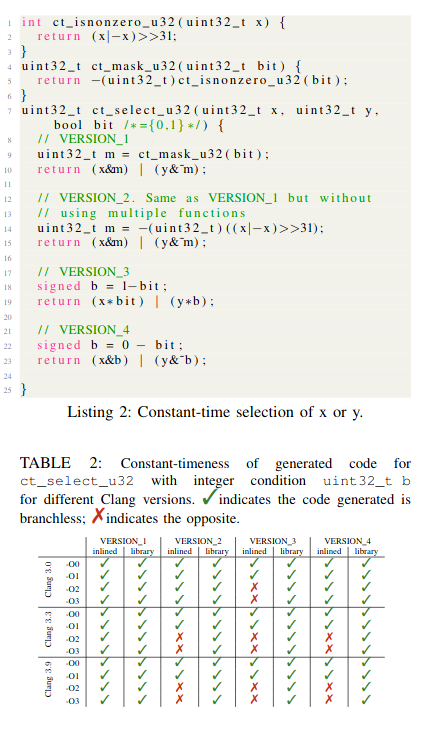
Another example is secure erasing secret data, which is often elided as an optimization.
Those are not theoretical exploits as explained in the When constant-time doesn't save you article (https://research.kudelskisecurity.com/2017/01/16/when-constant-time-source-may-not-save-you/) which explains an attack against Curve25519 which was designed to be easily implemented in a constant-time manner.
This attacks is due to an "optimization" in MSVC compiler
every code compiled in 32-bit with MSVC on 64-bit architectures will call llmul every time a 64-bit multiplication is executed.
Verification of Assembly
The assembly code generated needs special tooling for formal verification that is different from the C code in https://github.com/mratsim/constantine/issues/6. Recently Microsoft Research introduced Vale:
- Vale: Verifying High-Performance Cryptographic Assembly Code
Barry Bond and Chris Hawblitzel, Microsoft Research; Manos Kapritsos, University of Michigan; K. Rustan M. Leino and Jacob R. Lorch, Microsoft Research; Bryan Parno, Carnegie Mellon University; Ashay Rane, The University of Texas at Austin;Srinath Setty, Microsoft Research; Laure Thompson, Cornell University
https://www.usenix.org/system/files/conference/usenixsecurity17/sec17-bond.pdf https://github.com/project-everest/vale Vale can be used to verify assembly crypto code against the architecture and also detect timing attacks.
Assembly Performance
Beyond security, compilers do not expose several primitives that are necessary for necessary for multiprecision arithmetic.
Add with carry, sub with borrow
The most egregious example is add with carry which led to the GMP team to implement everything in Assembly even though this is a most basic need and almost all processor have an ADC instruction, some like the 6502 from 30 years ago only have ADC and no ADD. See:

Some specific platforms might expose add with carry, for example x86 but even then the code generation might be extremely poor: https://gcc.godbolt.org/z/2h768y
#include <stdint.h>
#include <x86intrin.h>

void add256(uint64_t a[4], uint64_t b[4]){
  uint8_t carry = 0;
  for (int i = 0; i < 4; ++i)
    carry = _addcarry_u64(carry, a[i], b[i], &a[i]);
}
GCC
add256:
        movq    (%rsi), %rax
        addq    (%rdi), %rax
        setc    %dl
        movq    %rax, (%rdi)
        movq    8(%rdi), %rax
        addb    $-1, %dl
        adcq    8(%rsi), %rax
        setc    %dl
        movq    %rax, 8(%rdi)
        movq    16(%rdi), %rax
        addb    $-1, %dl
        adcq    16(%rsi), %rax
        setc    %dl
        movq    %rax, 16(%rdi)
        movq    24(%rsi), %rax
        addb    $-1, %dl
        adcq    %rax, 24(%rdi)
        ret
Clang
add256:
        movq    (%rsi), %rax
        addq    %rax, (%rdi)
        movq    8(%rsi), %rax
        adcq    %rax, 8(%rdi)
        movq    16(%rsi), %rax
        adcq    %rax, 16(%rdi)
        movq    24(%rsi), %rax
        adcq    %rax, 24(%rdi)
        retq
(Reported fixed but it is not? https://gcc.gnu.org/bugzilla/show_bug.cgi?id=67317)
And no way to use ADC for ARM architectures with GCC.
Clang does offer __builtin_addcll which might work now or not as fixing the add with carry for x86 took years. Alternatively Clang does offer new arbitrary width integer since a month ago, called ExtInt http://blog.llvm.org/2020/04/the-new-clang-extint-feature-provides.html it is unknown however if code is guaranted to be constant-time.
See also: https://stackoverflow.com/questions/29029572/multi-word-addition-using-the-carry-flag/29212615